
If you love what you’re doing, it’s not work
Spike Lee on Michael Jordan, casting Rosie Perez off a speaker, and the year Denzel spent becoming Malcolm
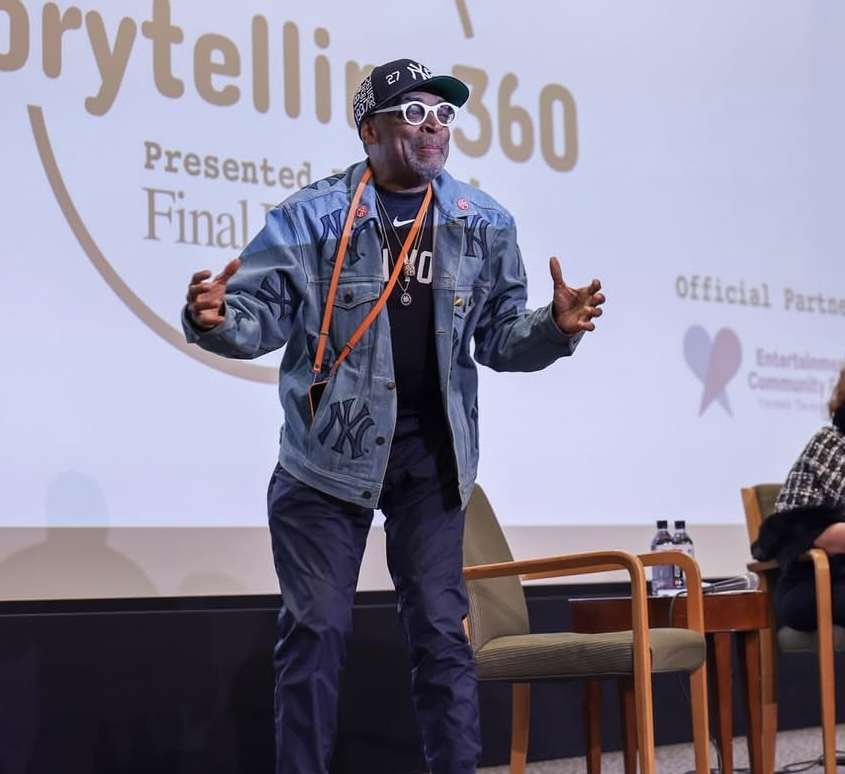
Spike Lee in conversation with Cynthia López, CEO of New York Women in Film & Television. State of the Story, New York.
Storytelling360 | Feature
Let’s start with She’s Gotta Have It.
Next year will be the fortieth anniversary of my first feature film.
The budget was a hundred and seventy-five thousand dollars. We shot it in two six-day weeks. Ernest Dickerson was the DP — we were classmates at NYU graduate film school. Ang Lee was in our class too.
We put the film together in stages. First stage: get the money to shoot. Second stage: get the money to take the film out of the lab, because this was before digital. Third stage: raise money so I could live on while we edited.
Laurence Fishburne invested in the film. Nelson George invested in the film. And a gentleman named Earl Smith, who I went to high school with at John Dewey in Coney Island.
During the early stages of raising money, Earl’s mother died. Her insurance came through — a cheque for ten thousand dollars. They had barely just buried her. And he said, Spike, take the cheque.
I said, I can’t do it.
He said, Spike, take the cheque.
He’s still getting cheques today. He was able to buy two brownstones in Fort Greene.
I didn’t even ask him. I didn’t know his mother had insurance. He just said, take the cheque. That’s an example of the help I’ve gotten throughout my career.
What was the hardest obstacle on that film?
Money.
What else you got?
And it led to Nike.
Jim Griswold and Bill Davenport worked at the advertising company that had the Nike account, and they saw She’s Gotta Have It. In the film I played a character named Mars who wore Jordans — he even took his Jordans off when he made love to Nola Darling.
So they called and said, we want to do a campaign with you and Michael Jordan, black and white, like the film. You’ll direct it, you’ll play Mars. But there’s one hitch: Michael Jordan doesn’t know who you are and he hasn’t seen the film.
Then I got a call back saying Mike said okay. And that put Nike into the stratosphere.
One of my big mistakes was that instead of taking stock, I took the cash. Messed up there. That was a big one.
For years I wondered — if Mike hadn’t seen the film and didn’t know who I was, why would he choose me? It wasn’t until a couple of years ago at NBA All-Star Weekend that I finally got up the courage to ask him. Why did you choose me?
He said: you were wearing my shoes.
Here’s what’s ironic. My parents bought our brownstone in Fort Greene in 1968 for forty-five thousand dollars. Michael Jordan was born at Brooklyn Hospital. So was Mike Tyson. They were both born in my neighbourhood.
What’s a day in the life when you’re shooting?
If we’re not shooting nights, call is 6 a.m. And we don’t go long.
Back in the day, before the Knicks revival, people on my crew knew that if the Knicks had a home game they’d be calling their wives saying, baby, I’m coming home for dinner. Because they knew we would not go long.
Playoff game? One or two takes. That’s it. Moving on to the next shot.
And when you’re not shooting? Your life as a creative?
That’s a very hard question. I’m not mad that you asked it, but it’s not uniform. It depends what the weather is, what my mood is.
None of that’s going to stop me, because I have a job.
Here’s what I tell my students — I’ve been teaching at NYU film school thirty years. Besides talking about this angle and that, I really stress work ethic. And I can tell in the first couple of classes who’s a hard worker and who’s shucking and jiving.
Here’s the key. This is probably the most important thing I’m going to say, so you can leave after this if you wish.
If you love what you’re doing, it’s not work.
I’m going to repeat that. If you love what you’re doing, it’s not work.
When we’re shooting days, call at 6 a.m., I don’t use an alarm to get up. I don’t hit the thing, hit the thing. I get up automatically, because I love what I’m doing and I know we’re going to have fun.
How many of you have a job where the alarm goes off and you’re like, all right. Raise your hand. Some of you are lying.
Look — you have a family, you have children, you have to pay the exorbitant rents here in New York. We all have to do what we have to do. But it’s not a given that you wake up saying, yes, I’m ready to go to work today. It can be a drag.
So when you find out what you love, that’s a gift. And to be able to do it and make money from it too.
Tell your story the way you want to tell it.
Spike Lee speaking on stage at State of the Story, New York
Do your own life and neighbourhood feed the work?
Yes, but not right away.
The Lees were the first Black family to move into Cobble Hill, in 1963. Back then Cobble Hill was solidly Italian-American. We got called all types of things. But after two weeks it stopped — you know why? Because there were no other Black families moving in behind us. So that fear of the whole neighbourhood turning went away. And my friends from back then in Cobble Hill are still my friends today.
It wasn’t until this past year that I figured out where the germ for Do the Right Thing and Jungle Fever was planted. It was us being the first Black family in Cobble Hill. I was six years old. I knew nothing. I wasn’t trying to be a filmmaker.
The human brain is a motherfucker. You don’t know what your influences are or how they happen.
And the opening of Do the Right Thing — Rosie Perez dancing to Public Enemy — that came from my mother taking me to see Bye Bye Birdie at Radio City Music Hall when I was little.
My father hated Hollywood films. My mother was a cinephile, and I’m the oldest of five, so my father wasn’t going to the movies. I was my mother’s movie date.
You don’t know how what you do can influence your children. Good and bad.
Did going to the movies make you want to make them?
Never. It wasn’t that deep. We went to the movies to have fun.
I’ll tell you a story. My mother loved Sean Connery. Loved him. So she took me to see Goldfinger. And I loved James Bond too — the Aston Martin with the ejector seat, all that.
Back then people went to the movies. It was communal. My mother always went opening weekend.
Now, you can’t do action for two straight hours, so there’s a lull. And in the quiet spot I asked my mother — in my six-year-old voice — Mommy, why is that lady’s name Pussy Galore?
The whole theatre heard it.
My mother grabbed me by the neck. On the subway home: don’t you say one word.
The audience laughed. That might have been the biggest laugh of the whole movie.
How do you handle the difficult days?
Part of the job. What else you got?
I mean, that’s the simple answer.
Go back to Do the Right Thing. The film premiered at Cannes, and right away the American press said this film is going to cause Black people to riot when it comes out in August. They hoped to God it wasn’t opening in your neighbourhood. That it would be the reason David Dinkins didn’t become the first Black mayor. That the blood would be on my hands.
That Mookie throwing a garbage can through Sal’s window was a cowardly act.
But look at what they left out. They put more weight on a pizzeria window than on a Black life. Radio Raheem was choked to death by the NYPD.
More often than not, I’ve been on the right side of these accusations.
And I’m not done. Mo’ Better Blues — I was called anti-Semitic because of the two characters played by John and Nicholas Turturro, Moe and Josh Flatbush, who ran the jazz club. As if in the entire history of music in America there has never been a single Jewish manager or label owner who exploited Black artists. So that makes me anti-Semitic. Which is bullshit.
But I’m still here. That’s the main thing.
The Oscars?
I haven’t had such a good relationship with the Oscars.
I guess Driving Miss Daisy was the best film that year — Do the Right Thing didn’t even get nominated. And I guess Green Book was the best film that year.
It got to the point where I was thinking: damn, every time somebody’s driving somebody somewhere, I lose.
I’m not the only filmmaker in history who thought they might have won. I don’t drag it around with me. Even though Do the Right Thing was 1989.
How do you find actors?
A director has to be a talent scout. You can’t rely a hundred per cent on the casting director. They’ll do their job, but you have to be looking.
The most famous story is Rosie Perez. It was my birthday in LA, celebrating the success of School Daze, and the hit song was “Da Butt” — we flew the go-go band out from DC to play my party. The club was called Funky Reggae.
And there’s this lady dancing on top of a speaker. I said to security, you’ve got to get her down, because if she falls and breaks her neck that’s the end of me.
They got her down and she cursed me out. And she had this very particular voice. I said, where are you from? New York. Where in New York? Brooklyn. Where in Brooklyn? Fort Greene.
She was from the Fort. At the time I was writing Do the Right Thing and I knew Mookie had to have a girlfriend. So I wrote that part for her.
And John Turturro?
I saw him in a film called Five Corners. This guy breaks into the Bronx Zoo and beats a penguin to death with a baseball bat. And then there’s a scene where he’s dancing with his mother, dancing and dancing, and he moves her toward the window — and throws her out of it.
I said: who is that guy? I’ve got to get him in a film.
And that was Do the Right Thing.
How do you direct actors as different as Jodie Foster, Clive Owen and Denzel Washington?
One word. Professionals.
They’re great actors, and I’ve been fortunate — they’re not crazy. We’re all there for one purpose. Do the work, go home.
That doesn’t happen automatically, though, so we rehearse. None of them had worked together before.
There’s no waiting five hours for it to be lit. An hour after call, we’re shooting. And we have fun. It’s not dun-dun-dun going to the set. We’re happy.
It’s not that we have to be best friends. You’re on the set, then you leave the set and do what you want. But we have the esprit de corps.
Malcolm X.
The original director was the great Norman Jewison, who’d worked with Denzel before. When I read that he was directing it, I felt a certain way. So a conversation was arranged, and he gracefully bowed out.
Denzel was amazing in that film. I’d seen him play Malcolm on Broadway in When the Chickens Come Home to Roost, so he was familiar with it. And for the year before we shot, he said: I’m not doing anything else.
He took a whole year to prepare.
You see biopics where the makeup and the hair make it look like the person, but it’s surface. Denzel knew that. He prepared for a year because he knew his soul, his presence, his heart had to be open to receive the blessings of Malcolm.
And it happened. There were many times — not just me, but Ernest Dickerson too — where we had to pinch ourselves, because we thought we were seeing the reincarnation of Malcolm.
There’s one speech I remember specifically. All the speeches were real, the exact words, taken from documented speeches. And remember we’re shooting 35mm — ten minutes and you’re out of film, you have to reload.
He got to the end of what was written and he kept going. Ernest looked at me. I was about to call cut and I said: don’t cut.
Finally we ran out of film and I called cut. I walked over to Denzel and his eyes were glazed over. Glazed.
He said, Spike, I don’t know what happened.
If he hadn’t put in that work the year before, that doesn’t happen. You’re not going to show up and do that off what somebody said the day before. He knew he had to be in a place spiritually and morally to accept that blessing. Because that was Malcolm speaking.
He couldn’t even remember what he said.
To me, that’s one of the greatest performances in a biopic ever.
And the recording studio scene in Highest 2 Lowest?
That’s Denzel and A$AP Rocky, and A$AP was tremendous — toe to toe with Denzel. It wasn’t like Denzel was going to run him over.
We start the scene, and Denzel starts dropping bars from Nas’s Illmatic.
I’m thinking, I don’t know where this came from.
And to A$AP’s greatness — he didn’t stop, didn’t say Spike, cut. He went with it. It turns into a rap battle and A$AP is right there with him.
That scene elevated the whole film. It became like an old western. High noon. It was way better than what was written.
Nobody knew he was switching it up. We just came in to shoot the scene.
What about AI?
Resisted.
I’m going to curse again. Fuck no.
You can call me an old fuddy-duddy, but I don’t care. There are things we haven’t seen. Where’s the soul? Where’s the heart? You want me to sell my label so some conglomerate comes in and takes all the soul out?
I get very finicky about non-humans in art forms. That’s just me.
And the thing is, it’s scary — this technology is so good you can’t tell. You see something and you think the person is saying it, and it’s not even the person. It’s dangerous right now.
What do you want to see from filmmakers coming up?
Tell their story. Simple. Tell their story the way they want to tell it.
That’s automatic. That’s what I’ve been telling my students for thirty years.
Tell your story.
Storytelling360 members can read the complete transcript of this conversation and watch the full session on demand.