
“No one in movie prison thinks they’re there for a crime”
Candace Bushnell, Warren Leight, Robert and Michelle King and David Guggenheim on ideas, notes, and pitching badly
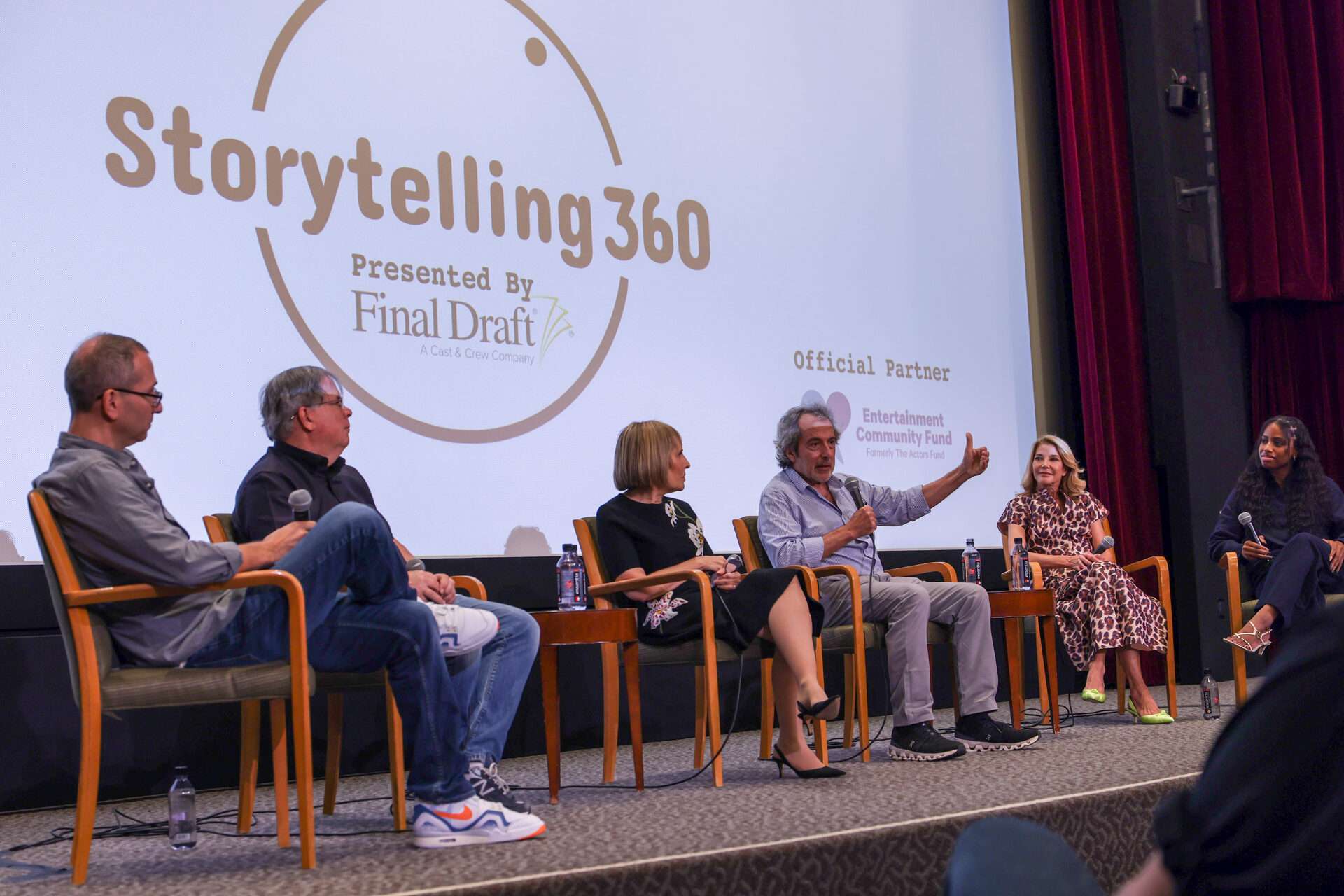
Storytelling360 | Panel
Edited for length and clarity.
Where does a series start?
David Guggenheim: Either it comes to me fully formed in that exact moment — lightning in a bottle — or, more often, it’s like fruit. It takes time to ripen. The idea hits, time passes, you start adding pieces, and suddenly it coalesces.
Robert King: For us it was combining two ideas. It was after the 2008 strike and we were desperate for work.
Michelle’s sister was returning to the law after raising kids, and she was thinking about starting a firm of smart women who’d dropped out to raise a family or nurture a husband’s career and then had to come back.
And then the Spitzer scandal.
If we find ourselves obsessing about something in the news and talking about it endlessly, eventually it occurs to us: oh, there’s a show in that.
Warren Leight: I had a movie once where I wasn’t solvent and I was desperately trying to find an apartment in Manhattan. Every place I looked at, I thought — I could afford this two days a week.
So I came up with an idea about three people sharing an apartment, each of them having it two days a week. One guy has his name on the lease, and he’s married but needs his little place on the side.
It was born entirely out of frustration. The joke led to the movie.
Sometimes when you’re trying really hard to think of it, it doesn’t come. And then it’s the offhand thought — if you can grab it — that leads to something.
Candace Bushnell: I’m mostly a novelist, so my story’s different. Something feels like it has legs when somebody buys it. You pitch it, somebody says yes, and you think: okay, this has legs.
How do you know an idea is worth fighting for?
Candace Bushnell: Other people’s response to it. If they attach to it, understand it, relate to it — and bring their own ideas and their own visions to it — that’s what makes the difference.
David Guggenheim: Passion. Yours, and theirs. If you’re getting that enthusiasm back from people, it fires you up.
But a lot of the time you’re writing from scratch. I’m primarily a spec writer — nobody’s paying me. So the question is whether the next six months of my life, or however long it takes, are worth it. You have to believe in the idea and believe you can execute it.
Michelle King: It’s more about what you don’t do. If you have five or six things you want to pursue and you keep hitting no, no, no — and then someone responds to one of them, you go: okay, that’s the one.
Robert King: And episode by episode, we found that if the writers start arguing in the room and fighting about something, that’s when you know you’ve got an episode.
Warren Leight: There was one thing I wrote that nobody wanted to see. And it was my biggest hit.
Say more.
Warren Leight: I’d been one of the writers on a movie that didn’t do well, and I went to movie prison for two years. I was up for jobs I didn’t want, terrible ones, and I wasn’t getting them.
I asked a more experienced friend what was going on. He said: your movie bombed. You’re in movie prison.
I said, but it’s not my fault.
He said: no one in movie prison thinks they’re there for a crime. They’re all there for a crime they didn’t commit.
So I was out for two years. And I’d spent twenty years telling stories about my childhood — my dad was a jazz musician, there was a little family dysfunction. I’d done stand-up about it. I’d written short stories about it in college.
And I thought: I’ll do a play. Nobody will come, it’ll never get made, but they can’t screw it up. Because it’s mine.
I spent four or five years on it. Readings in my apartment. Eventually a reading in a bar. The director had someone he thought was right for the dad, and I had a woman I thought was right for the mom.
That was Edie Falco. She was waitressing at the time.
And it still took four more years. It got rejected by every theatre in New York — some of them twice. Because it was about jazz musicians, and nobody wants to see jazz, and the language is foul, which is a problem.
Eventually it got a seventeen-night run off-off-Broadway. Then Broadway. Then a Tony.
The things that had to happen for it to get its little break are ridiculous. I ran into Edie on a bus — the Ninth Avenue bus going downtown, on Valentine’s night, which tells you how well both of us were doing. And I was so dumb about it. I said, Marisa Tomei was going to do the reading but she got a job, do you think you could do it?
And she said yes. And that changed both our lives.
The utter randomness of a Ninth Avenue bus.
The only lesson I draw is that I kept going. But you could keep going and not have it happen. I got lucky.
David, you’ve described a similar low.
David Guggenheim: I worked for a magazine for ten years. I’d been sending out specs since college. About ten specs over ten years. Nothing sold.
I was married. I had a kid on the way. The job was seven days a week — it was a weekly, so you were constantly in the office. And I genuinely felt I couldn’t juggle a struggling writing career, a full-time magazine job, a wife and a new baby.
I was desperate to sell something, because I didn’t like that job at all.
So I wrote a spec and gave it to my agent. And he hated it.
That’s when I felt completely defeated.
I had about two months before my daughter arrived. And I wrote the first spec that ever sold. Safe House.
That changed my life overnight.
The lowest possible low, and the desperation fuelling it, turning into a good moment.
How do you keep your vision in a collaboration?
Robert King: We collaborate with each other, so we’re passing it back and forth already. And we made a home at CBS — we trust the collaborators there, and they trust us.
One year we said we were going to do a season about tort reform. And they said, oh — okay. I bet you can do it.
But it landed like a fart in the room. So we went back and did a season about kill all lawyers instead.
You have to stay aware that you’re trusting your collaborator, and if they’re just not feeling it, rebooting and rejigging is fine.
Warren Leight: And sometimes they don’t know what’s wrong. The diagnosis is wrong and the prescription is wrong.
I’m on a show now where I get notes from Wolf Films, from Universal and from CBS, and they’re not going to be in line with each other. But usually it means something is off, or they wouldn’t all be getting agitated.
Robert King: Which is why on notes calls it’s important to say: don’t look for your note to be answered here. We’re going to answer it holistically across the script. Because executives will say, well, I told you to do that — and you say, no, that wasn’t the way to answer it. We did this instead.
David Guggenheim: It’s like being at a bar and someone tells you you’ve had too much to drink. You don’t believe them. But when three or four people tell you you’ve had too much to drink — you’re probably drunk.
That’s how I feel about notes. If a lot of people are coming at you, don’t assume you’re the smartest person in the room.
I worked at a magazine for ten years before I sold anything, so I got used to collaboration very fast — different departments, different creative people, at a brand I wasn’t the audience for. I got thrown into the trenches of working with collaborators and seeing how important it is when you’re all going for the same goal.
Who else is a collaborator?
Robert King: Number one on your call sheet, and that’s a roll of the dice. We’ve been fortunate — people who are smart and nice and respectful, often from theatre, where there’s deference to what’s on the page.
But you can get someone who’s confrontational, who assumes whatever’s in the script is wrong and has to fight it. That can be god-awful.
Also your designers. I never know where a good idea is going to come from. Some kid in the hallway will say, you know, this is the fourth time you’ve had a lawyer do that. If your crew is engaged and knows they’re part of something creative, good ideas come from anywhere.
Warren Leight: We shot a scene two days ago — an office for a video conference — and the designer made a beautiful office for it. And I’m working on the next episode and I thought: okay, we’re not video-conferencing with this guy in DC. Our guys are going to DC.
Your costume designer knows something about your character. Your actors, ideally, know their character better than you do at a certain point. Don’t be too precious or on guard.
The production designer, the costume designer, the location scout — a remarkable resource. That’s why I went into theatre, and then TV.
Candace Bushnell: As a novelist I don’t collaborate at all, and that’s been the hardest thing to learn about television.
When you’re a novelist it’s you and the page. In TV it’s literally hundreds of people. Books and movies are much more similar, because they have a beginning, middle and end. A TV series is the opposite.
So I trust the people I’m working with. I figure they probably know more than I do. That makes it easy.
How do you pitch?
David Guggenheim: I write it out. I script the dialogue for what I’m going to say.
Zoom has become helpful, because I can have the script on screen. I’ve got really good at maintaining eye contact while I’m really just reading it.
Pitching is a skill. Its own art form. And because I have confidence issues with everything I write, I tend to write the script first. Sometimes I reverse-engineer it — write a vomit draft, then distill it into a pitch afterwards.
Candace Bushnell: I’m about to pitch a series based on one of my books, One Fifth Avenue, and we’ve spent the last six months writing the pitch and all its elements.
It’s quite strict. No more than twenty minutes. A lot of rules.
I’ll let you know how it goes.
Robert King: It’s been a tough year to sell a pitch. So superstitions develop that a studio or an executive producer will share with you. Oh, you should have pictures on screen. Oh, never put pictures on screen.
At the end of the day, they wanted to buy something that day or they didn’t.
David Guggenheim: And things work as a pitch that don’t work as a script, and the reverse. It’s a crapshoot. Bringing in a star helps smooth it. But a pitch is its own beast.
Robert King: And it’s on Zoom now, which means you almost have to be an actor. You don’t have the energy of the room and it’s hard to read whether people are engaged.
It really helps to pitch with someone you live with, because they laugh at your jokes and you laugh at theirs. We script it, and we script it to build tension. I might do a long piece, then Michelle does a long piece, and as the pitch goes on the pieces get shorter and shorter, so by the end we’re almost Abbott and Costello.
Warren Leight: I can’t sell anything.
I usually get brought in to fix what others have messed up, and then I can sell the fix. But something happens to me when I go to LA. I’m not funny. I don’t get the rooms.
So if you can’t pitch — join somebody else’s thing. Honestly. Not everybody can pitch.
On this panel, I think the people who pitch can also write. But I’ve been in rooms with people who can pitch anything and can’t write a word. And it’s dispiriting when you hire that guy onto the staff. They interview really, really well. They come into the meeting and you think, Jesus Christ, this guy’s going to take over the show in three weeks so I can go to Rio.
David Guggenheim: That’s my entire career, by the way. Just pretending that I’m good.
Do you think about the audience?
Candace Bushnell: In the sense of keeping them entertained. Not a specific audience.
I tend to do things oriented towards a female audience, and then the reaction is: well, what are the men going to watch? They’re not going to watch this.
So I’m a little cautious about that. But it’s really about keeping the audience entertained and stopping them scrolling on their phone.
Robert King: Our audience is my family. They’re very large, very loud, and very vocal about what they don’t like. They did not like Kalinda having a boyfriend.
David Guggenheim: I don’t write for an audience, because an audience doesn’t see the script. I’m writing for the reader of the script.
In the edit room I’m thinking about the audience. But at the writing stage it’s almost too big. Let me think about it smaller — focus on the words, the craft, the script, getting those first reads. And then hopefully the idea is commercial enough that it finds an audience.
What’s left on the bucket list?
Warren Leight: I grapple with this. A lot of the guys I went to high school with are retired now.
When I had success with Side Man, somebody gave me the Pete Hamill book about Sinatra. I’d just had the nice reviews and won the awards. And the line in it was about the professional being the guy who can do it twice.
And that messed me up.
You say you want to retire. But the truth is you want to see if you can do it again.
I’ve got a show on CBS now, and it’s a different time to be writing for network television. Things are tricky politically. It seems to me a less free environment than ten years ago — everyone’s looking over their shoulder. So the question becomes: what can you do within that?
And you get more facility as you go. Weirdly, I’m older but I make decisions faster now. I work with directors where I think, there’s not a scene I can write that this guy can’t shoot — he’s got it under his fingers. And no matter what script I get at this point, it’s unlikely I can’t make it better, because that’s been my job across two hundred and fifty episodes.
So what can you do with the chops you’ve been working on for forty years?
I love old musicians who get on stage and it’s just under their fingers. There’s no such thing as a wrong note for them, and they still play, no matter where they play.
I’d like to be an old tenor sax player.
David Guggenheim: Every writer is always seeking to emulate the work that inspired them as a child. For me it’s high-concept original TV and film — churning out as many of those as possible.
Robert King: We had Frank Pierson in the writers’ room, who wrote some of the best movies ever made, and he’d started in TV. He was in his late eighties.
That’s the bucket list. To be able to write into your eighties and still want to.
Michelle King: Just to keep going. Which seems to get harder as you get older.
Warren Leight: Persevere.
One year we said we were going to do a season about tort reform. And they said, oh — okay. I bet you can do it.
Robert King speaking on stage at State of the Story, DGA Theater, New York
This conversation is drawn from Television at the Top, a panel discussion at Storytelling360’s State of the Story conference at DGA Theater, New York. Storytelling360 members can watch the full session on demand.