
This page contains paid links. As an Amazon Associate, Storytelling360 earns from qualifying purchases.
You’re a filmmaker. You just haven’t made your film yet.
Kevin Smith on his sister’s advice, the book he can’t finish, and why the indies are coming back
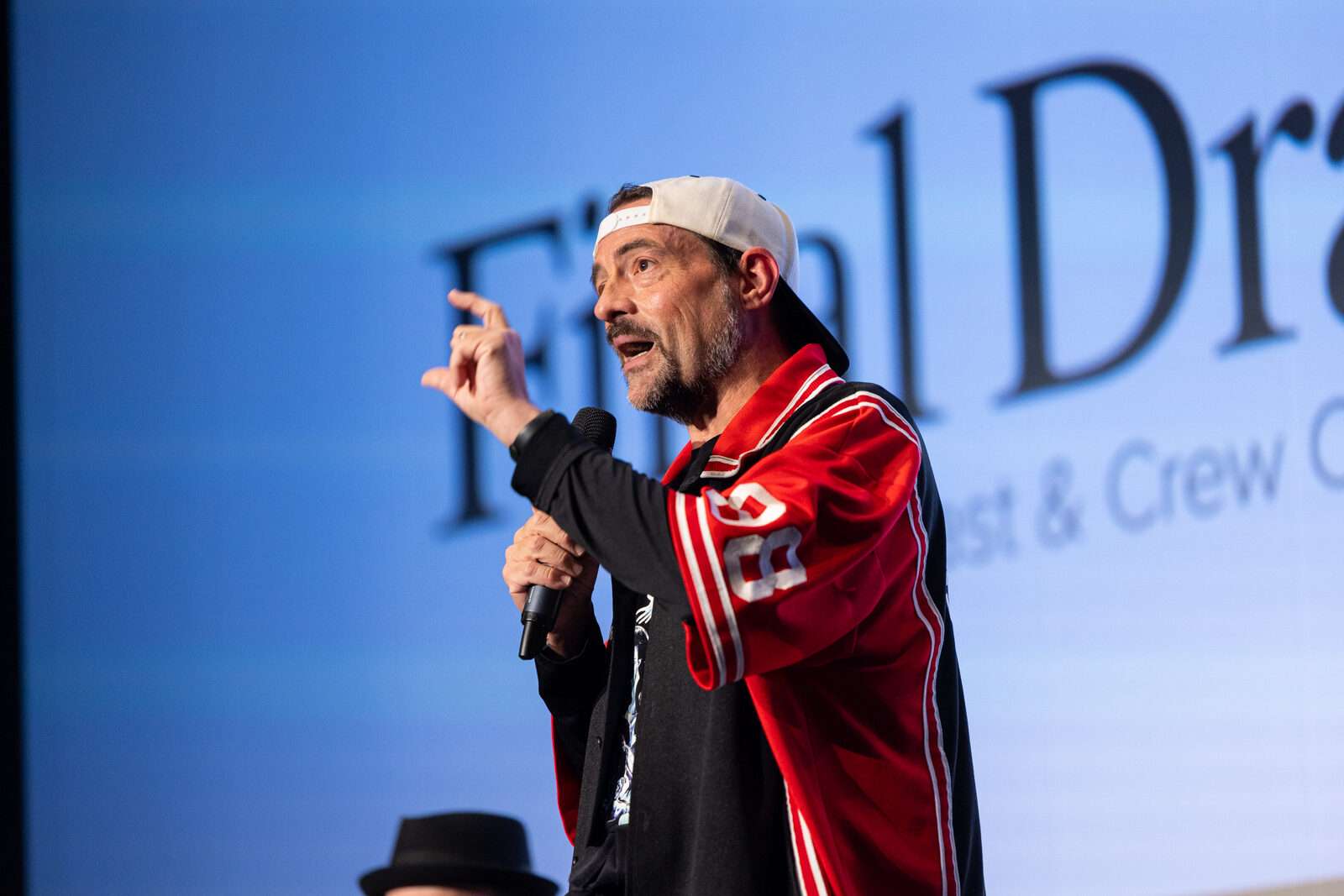
Kevin Smith in conversation with Jeff Goldsmith of Backstory Magazine. State of the Story, Los Angeles.
Storytelling360 | Feature
You’re working on a book.
I need to be around a bunch of f*cking writers. I’m having a hard time finishing a book, man. I’m beyond deadline.
And honestly, I don’t think it’s writer’s block. I just can’t stand the idea of writing prose right now. I was in a real script groove, and scripts are fun — the format is fun, and you can go through pages. I can sit there and do sixty pages a day and you’ll see it get thick.
But prose, you spend hours writing and at the end of the day you’re at two thousand words. Four thousand words. Like, this sucks.
How far in are you?
Not far enough. About halfway. But there’s a big section coming up about the death of my mom.
My mom just passed away. In December, ten days shy of her eightieth birthday. It f*cking sucked.
The whole book is predicated on living eternally youthful. And the final lesson my mom imparted by dying — rude — is that you can’t be a kid anymore. Once both your parents are dead, you are the adults in the room.
So she gave me a way to finish the book.
Which means I have to write about my mom. Normally I’d love to write about my mom. I was a big fan of Grace Smith. Writing about her now is going to be misery and pain, because she’s gone.
So what I thought about doing — I’ve been writing a lot of comic book scripts lately — is I’ll write it as a comic book script and have somebody draw it. It’ll be different presentationally, but I’ll get through the story in a way I’m comfortable doing. And more importantly, I’ll get it done.
If I’m just staring at a wall of prose after a wall after a wall, I don’t know that I could do it at this point. Particularly with that subject matter.
When did you know you wanted to be a storyteller?
I was six. I was going through my sister’s stuff, went under her bed, and pulled out a composition notebook. There was a crude drawing of her and her friends on the front — I could tell, that’s Virginia, that’s her friend Patty. And it said The Secret of the Cellar Door.
My sister came in and said, what are you doing? I said, what’s this?
She goes, I’m writing a book about me and my friends.
And I got so incensed. I said, you can’t just write a book. You have to ask the government first.
She goes, why do you say that?
I said, because when we go to the library there’s little eagles on the card. You can’t just write a book.
And she gave me the most useful advice I’ve ever received in my life. She said: Kevin, you don’t ever have to ask anybody for permission to write. Especially the government. Anybody’s allowed.
She said, if it was going to be in a library or a bookstore it’d be published, and then it’d have to go through somebody. But I’m just writing it for the fun of it.
I was six. But the concept of doing homework that wasn’t homework — the idea that you’re electing to do this — captured my imagination.
And the first thing you wrote?
By nine I’d been messing around with the electric typewriter we had. Plug it in, it came to life, humming loud. Press a button and it felt like the beginning of All the President’s Men.
Jean Shepherd wrote a book called In God We Trust, All Others Pay Cash. He was an essayist — the guy responsible for A Christmas Story. They based that movie on short stories from his essays. And I loved the way he wrote, because I was a big fan of A Christmas Story, so I went looking for his books.
I loved the idea of the personal essay.
So — and oh my God, it’s so ironic, I needed to say this out loud today — I sat there and wrote a story about going to my relatives’ house, which I hated. Very satirical, blew them all up into monsters. Four or five pages, not double spaced. A wall of prose.
That’s how it all began. With prose. You stupid, stupid man.
And when I was done I showed it to my brother Donald. Donald is the greatest audience on the planet. If you can get him laughing he loses consciousness. He laughs so hard he can’t breathe. He doesn’t know how to laugh properly.
He started cracking up. And that feeling — that sense of gratification when he laughed, and not at me but with it, because he recognised all the people I was writing about — made me a lifelong acolyte.
Suddenly I was just like: this is what I want to be.
It will cost me nothing to try.
Kevin Smith speaking on stage at State of the Story, Los Angeles
And filmmaking?
I saw Richard Linklater’s Slacker on my twenty-first birthday, August ’91, at the Angelika.
The only way I can describe watching it is a mixture of awe and arrogance. Awe, because I’d never seen a movie like it — no movie stars, no car chase, just life in this city and nobody famous in it. And arrogance, because I thought: well, if this counts as a movie, I think I can make a movie too.
By the time we got through the Holland Tunnel I said to my friend Vincent Pereira — he was the one who wanted to be a filmmaker, first person I ever met who knew what he wanted to be — I said, I think I want to be a filmmaker.
I’d had weird rules in my head. I thought you had to be from Hollywood. Vinnie pointed out that Spielberg wasn’t; he was just from out in California and snuck onto the lot.
And I dreamed about writing for Vinnie. But after Slacker I said it out loud. And part of it was, if I direct then I can protect my words. I had this paranoia as a young writer that if I wrote for Hollywood they’d change whatever I wrote — assuming I was lucky enough that they’d buy it at all.
Then I told my sister.
I said, I saw this movie in the city, and it made me think I can do that. So I think I want to be a filmmaker.
And she goes, oh my God, great — be a filmmaker.
I said, yeah, that’s what I’m going to do. I think I’m going to be a filmmaker.
She said: no. Be a filmmaker.
I was like, what game is being played here?
And she goes: you talk about wanting to be. And as long as you want to be something, it’ll never come. So stop wanting to be it. You’re a filmmaker. You just haven’t made your film yet.
It sounded very artsy-fartsy at the time. I remember saying, Virginia, you’re wrong.
But the next morning I got up and thought: it will cost me nothing to try.
And from that moment I was a filmmaker who just hadn’t made his film yet. People online say fake it till you make it. I wasn’t faking it. It just sounded like pretty decent advice the morning after. And it worked. It got me where I was going.
I owe my sister a call after this.
Why is there gay content in all your movies?
That’s for my brother.
My mom outed my brother to me right before I started writing Clerks. I came home from work and she said sit down — I thought something had happened to my dad. She said, I have to tell you about your brother. Your brother’s gay.
And for half a second I was like, what? And then everything made sense. I thought, that totally tracks.
I said, why didn’t he tell me? Me and my brother are close. Does he think I don’t like gay people? Is he not telling me because he’s scared I’ll be mad?
I was going to film school in Vancouver in ’92, and my brother flew out with me and we drove up from Washington. So I had this plan: it’s going to be just me and him in a car for hours, that’s when we talk about it.
We talked about everything under the sun except that. Crossed the border. Still hadn’t touched it. And then I could see the glass buildings of Vancouver on the horizon, and I turned and said: so I understand you have an alternative lifestyle.
And he said, that’s one way of putting it.
And then I asked him everything. If you’ve seen Chasing Amy — the scene where Banky is interrogating Alyssa, asking is this real, is this real — that came from that drive.
And one of the things I asked him, because I was going to film school, was: what about when you go to the movies?
He said, what do you mean?
I said, every movie out there is boy meets girl and they fall in love.
He said, well, I understand love. And I groove on the fact that they’re in love. But no — I don’t really see myself up there, unless I’m mincing or a sidekick.
That broke my heart, man. Because cinema for me was a church. I was in Catholic school eight years and an altar boy for twelve, and I didn’t learn anything sitting in church. Everything I learned about myself I learned sitting in the darkness of a movie theatre.
And the idea of my brother not having that same experience, because nobody up there was talking to him —
So I made a vow early on: I’m always going to put some gay content in there for my brother. That’s why Jay and Silent Bob are always talking about sucking dick. So that when my brother’s watching, he’d feel addressed. Like, never mind this breeder sh*t, this one’s for me.
First time he saw Clerks, he said: you talk a lot about dick-sucking in that movie.
I said: that’s for you, man.
Chasing Amy is in the Criterion Collection and won an Independent Spirit Award.
That I’ll gleefully take. I don’t like compliments — I love Kevin Smith, but when people say you did this, I go, no I didn’t. But I did do that.
That movie hasn’t aged as well with certain segments of the audience over the last ten or fifteen years. There’s a wonderful documentary by Sav Rogers called Chasing Chasing Amy which is literally about that.
Young people watch it now and go, what the fck? The biggest complaint I’ve had for years is why doesn’t she just say she’s bisexual?* And you have to understand — it was 1996. We didn’t have that word yet, not in common use. It was a dichotomy of two. You were straight or you were gay.
At its time, that movie was trying to do something, and in some ways it succeeded. Through a different prism, it doesn’t age as well for people coming to it new.
But there are a bunch of people for whom that movie was a buoy in a stormy sea. Sav being one. I’ve met many cats like Sav who said, Alyssa Jones kept me from killing myself, because I thought — one day I’ll go to New York and hang out with people who don’t make me feel like this.
And that’s the beautiful thing. You go into this because of you. It’s selfish. You want to write your name on the wall. And then if you’re lucky — and I’ve been at it thirty-two years — the priorities completely shift and it becomes something else.
Say more about that.
I was at a convention in Dallas a year and a half ago. People come up, they have you sign photos, DVDs, posters.
This guy had a VHS of Mallrats and it looked like it had been through hell. Like it came from 1995 through some rough trade.
I said, look at this American relic, this thing’s seen some wear.
He goes, I’ve had it since 1995. Can you sign it for my son?
I said, is your son old enough for it? He said no. But I want him to have it. It was my favourite movie.
And I said — where were you when this came out? We really could have used the help.
And he said, funny you say that. Because your movie helped me.
He said, I grew up in a house where my father beat me every day after school. I’d come home and he would lay hands on me and beat me within an inch of my life. And when he was done, I’d crawl to my room and lock the door and put in Mallrats, and me and Brody and T.S. and Jay and Silent Bob would just escape.
He said, that’s how I got through that house. Now I’m a father, and I would never do to my kid what that piece of sh*t did to me. But I need my kid to understand that I survived so he could get here. And this was my key to survival.
And it was Mallrats. Not Dogma. I get it, Dogma‘s a classy film.
You never know what it is you’re doing that saves somebody’s life. I swear to Christ, when I was making Mallrats, I never once thought: this will save a life.
You built an online audience before anyone else did.
Mallrats tanked so hard. We spent five million making it and made two million back. I thought I was going to have to give Universal three million dollars back — I didn’t know how it worked. PS, it doesn’t work that way at that price.
A friend said, you should go online, there are Clerks shrines. I said, what is that?
So I went to the Internet Cafe in Red Bank and paid five bucks. Google didn’t exist yet. And the guy got me to Ming Chen, a college student at Amherst who’d loved Clerks so much he built a website about it.
First website I ever saw. I didn’t have the terminology, so I described it as a magazine on a television. Still and beautiful like a magazine, but on a screen.
I asked him to build me one. We put together View Askew. And right before we posted it he said, is there anything else you want? I said, I love doing Q&A — could I get online once a week and talk to people?
He said, that doesn’t exist yet. But I’ll put up a BBS board. Just a board where people leave questions and you answer whenever you want.
Essentially Reddit. Every time I go to Reddit it looks like the old View Askew board.
And the moment I went to that board I realised I’ll never be alone again. Because there were people sitting there going, you have the information we want, we’re here because you made a thing.
I wasn’t building a community. I went there to lick my wounds, because I’d heard some people liked my stuff.
Somebody told me there was another filmmaker doing this. I said who? They said, the guy who made Bad Taste. I said, Peter Jackson? They said yeah, he answers questions like you.
Peter got smart. He got offline and won Oscars. I’ve stayed with it ever since.
Wasn’t it risky, talking about a script that hadn’t been made?
It wasn’t fearless — my script was already up on Drew’s Script-O-Rama. You could read it. So I figured, well, anyone can read it now, I might as well talk about it.
And in the early days of the internet you genuinely felt like you knew everyone. Somebody asked me once what I thought of the internet and I said, oh, it’s great, I did all of it. Because there were about a hundred websites. You could cover it all.
I was never that interested in what critics had to say. Miramax was very critic-driven so that got drilled into us, but it always seemed backwards to me. That person sees the movie for free, and if they write something bad it hurts the movie. Meanwhile the people who pay to see it, I don’t get to talk to. They’re just figures on a piece of paper.
And that audience stayed.
Jason Reitman came up to me at Sundance and said, you’re the reason I’m a filmmaker. I said, I think your father Ivan Reitman is the reason you’re a filmmaker.
He said no — I grew up on the Ghostbusters set and never once thought about making Ghostbusters. When I saw Clerks, that sounded like me and my friends. And it made me want to make a movie.
He still had the ticket stub. Showed it to me years later.
We did our first Chasing Amy screening pre-Sundance because the website existed. I said, write an essay so we can figure out who gets to come — and then we just let everybody come. A hundred and fifty people showed up in New Jersey.
Janet Pierson was like, Kevin, this is crazy, these people could kill you, you don’t know who any of them are. So she and John came to make sure I was okay. And after the screening we took everyone to the store and signed things till the small hours.
And Janet said: oh, I get it now. You can’t stalk a person who’s in your face like Kevin is.
My star has faded so many times I can’t count. And whenever it’s on the wane, when no studio’s interested because they think they’ve seen everything I can offer — I still get stuff made. Because I’ll be in a meeting and someone says, well, he does have that audience.
That’s who they’re talking about. It’s the only reason I still make these movies.
Red State. You auctioned the film to yourself on stage at Sundance.
Me and John Gordon conducted an auction. He opened the bidding, I bid twenty, he said sold. We sold it to ourselves.
And then I turned around and lectured the audience for twenty minutes.
Because we made Clerks for peanuts and they spent twenty million marketing it. I could have used that money to make a better movie. Instead I asked everybody to cinch their belts and work for nothing, and then they poured money syrup all over it to attract people who weren’t Kevin Smith fans.
My whole career, that’s all I heard. Your fans are showing up. We’re trying to get the Kevin Smith fans that don’t exist yet.
And I’d say: Kevin Smith has all the fans he’s ever going to get and need. Rely on them, you’ll save a lot of money.
If you make a movie for forty million and someone wants to spend twenty marketing it, that makes sense. You make a movie for peanuts and they spend four times what you spent — that sat in my craw.
Lionsgate was in the front row. I said, there’s a standard Lionsgate twenty. And they were like, he’s talking about us.
Lionsgate ended up being the company I worked with most in my later career.
I stuck with that model and I still do it. Clerks III, the Jay and Silent Bob Reboot, and Store Wars when it comes.
What happens when you take something to a studio now?
I’ve been in this business thirty-two years. Let me tell you about two projects, because this is important for young writers to hear.
The first was a sitcom at Universal. The logline was basically Only Murders in the Comic Book Store — a comic shop crew who solve local crimes based on comics they’ve read. That happened in Batman 227, that kind of thing.
Universal loved it and became our studio. We went to NBC first, because they’re in bed together, and NBC took it off the table — we love it, we’ll pay you more, do it here.
We spent a year writing it. Handed it in. They greenlit a bunch of shows and ours wasn’t one of them.
And then they gave me the weirdest note I’ve ever received in my life.
They said: you know the murder mystery sitcom you’ve written? Can you do it without the murder mystery?
Which was the only reason to buy the show.
I said, I guess — why? They said the murder mystery doesn’t sell with us, but we love the characters and the interplay. We think it could be a fun hangout show. Can’t they just be at the store working and talking to each other?
I said: oh. Like Clerks?
So we did a Clerks version of it for another full year, turned it in three months ago, and they passed. Not in a sh*tty way — they said, nah, we tried it, we didn’t like this one either.
The other one was Danny Phantom, Butch Hartman’s cartoon, for Nickelodeon and Paramount. Live action. My take was: just do it like a CW show, nobody’s making CW shows any more.
Developed it for two years. Got all the way to Netflix. They were into it, started making a deal over six months. And in those six months the Warner Brothers thing happened, and it looked like Netflix might get Warner Brothers, so Paramount said we don’t want to be in business with Netflix. Gone.
So I said fine, we’ll do it at Paramount+. And they said Paramount+ doesn’t make things for kids. It’s all Taylor Sheridan over there. You got one of those?
I said, f*ck no. I wish I did.
Two projects. Two years each. I can get into any room in this town. Doesn’t mean they’re going to buy anything. And they love sitting down with me, because as you can see, I’m kind of entertaining.
Do you feel part of the business?
I never feel like I’m part of this business.
I watched the Oscars for the first time in years because my wife wanted to. And it’s strange, because there are people in that audience I know, or have met. But I never feel like I’m in that business.
There are many different movie businesses, and I’m not in the one most people think of. I live in Hollywood, but I’m not really of Hollywood. And not because I don’t want to be — I’d love it if they liked me. My stuff’s just not for everybody.
I’m thirty-two years in and I’m still making a living at it, without a Warner Brothers deal or anything like it. So that’s possible too.
There’s going to be a lot of no out there. And sometimes you get paid and then it winds up being a no anyway, and in those moments I think — at least I got paid. It’s always good practice to write, even if it doesn’t go into production.
Your favourite Robert Redford memory.
I’ll give you the only one I have.
I went to Sundance in ’94 for Clerks, ’97 for Chasing Amy, 2000 as a judge, then Red State, then 2016 with Yoga Hosers.
Never met him.
After the first one my mom asked, did you meet Robert Redford? She loved Robert Redford. I said no, I saw him at a distance. Then there was a piece on Entertainment Tonight where he gave a quote about Clerks, and my mom called me up going, he did see it! And I thought, that’s pretty generic, he might have just said it’s funny and it’s black and white.
The Yoga Hosers year there was the filmmakers’ brunch. In ’94 me and Scott Mosier tried to go but got lost in the mountains and missed it. Every year after, I didn’t bother.
That year I was up early, by myself, smoking, and I thought — you’ve never gone. You’re the only one awake. Just go.
So all the filmmakers are in a room eating, and Redford gets up and does the speech he’d done a thousand times. And I’m at the back, leaning on the wall.
There’s the initial thrill of oh sht, Bob Redford.* But as he talked about his journey — being an actor, having some success, and using that to break off a little money for independent film because that’s where the interesting movies were — as he told that story he’d told a gazillion times, I started crying.
Because I realised: I don’t get to make my journey unless he makes his.
I never met that man. And he was absolutely necessary for me to go where I went. Without Robert Redford, we’re not having this conversation.
How did Clerks get into Sundance?
We didn’t make it intending to apply. Sundance to me felt like — that’s where they make colour movies with famous people. sex, lies, and videotape was in colour and had James Spader, who’d been in Pretty in Pink.
Bob Hawk saw it at the Independent Feature Film Market and said, you have to submit this, this is the kind of movie Sundance needs. I said that’s never going to happen.
I was working at the Quick Stop, behind the register. We had a payphone. It rings, and it’s Bob.
He says: Kevin, I want to tell you that Clerks has made it into the final twenty films. Four hundred were submitted. Now they’re bringing it down to sixteen. And there are some people here who really liked the movie, and some people here who don’t think it belongs at this festival. But I thought you needed to know you made the top twenty. That’s absolutely something.
I said, thanks Bob. Hung up. And I got ready to salve my wounds — I guess that’s as good as it gets.
He called back twenty minutes later. He said: it’s written in stone. You’re in the Sundance Film Festival.
Without that, nothing.
I’d intended to four-wall Clerks. Take it to theatres in New Jersey myself and try to recoup the money I’d put on credit cards I didn’t even have.
And here’s the thing — in 1994, nobody had ever sold a movie at Sundance before. The first was Go Fish, Rose Troche’s film. The second was Clerks, a week later.
So I got ready for a life I didn’t lead for the first twelve or fifteen years. And then eventually I got right back to four-walling — taking the movie to a theatre, renting it out, filling the seats myself. Which is how I’ll probably spend the rest of my career.
Where’s the business going?
Don’t be disheartened, kids. Everything’s consolidating, sure. But that just means this is the rise of the indies all over again. I’ve been around long enough to go through it twice.
History doesn’t repeat itself, but it sure rhymes.
When we started I followed kids who were my heroes — Linklater, Jarmusch, Spike Lee, Hal Hartley, Quentin. They started singing their song because no studio was ever going to record it for them. They got tired of waiting for a turn, and said f*ck it, we don’t need that system, and built their own thing outside it. And I got to be part of that.
With all this consolidation they’re going to make fewer movies, and those fewer movies aren’t going to take chances. It’s going to be hardcore sequels and remakes time.
So where do the interesting things come from? Streaming, sure. But also the indie sector. It’s going to happen again. I can feel it. I’m banking on it.
It’s like standing outside a hockey rink watching people play. You think — I don’t have skates, I’m not a professional NHL player, but that looks fun. And if I get a stick and a ball and we’re on pavement, I think I can make this work too. Our version of it.
And it’s not bad when people forget about you for a while, because it lets them rediscover you. Right now it’s not even my time. There are so many other talented people. I’m happy to keep the Kevin Smith thing going in the background. It’s time for others to shine.
They’re waiting to hear you.
Mentioned in This Talk
Paid links