
This page contains paid links. As an Amazon Associate, Storytelling360 earns from qualifying purchases.
Then your heart either sinks or it soars
Sir Stephen Frears on the letterbox method, not storyboarding, and why he doesn’t have visions
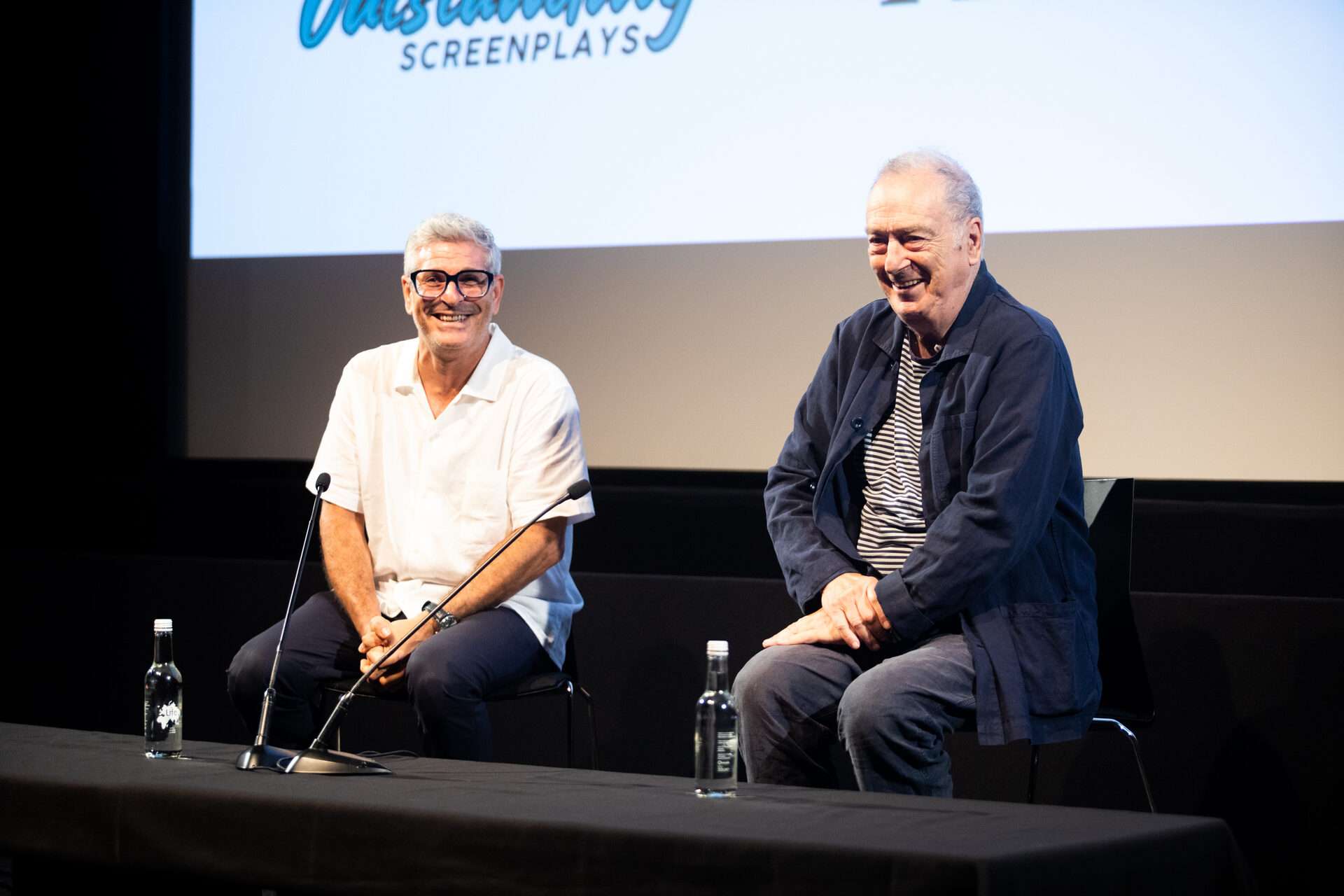
Sir Stephen Frears in conversation with Jason Solomons. Storytelling360 at the British Film Institute, London.
Storytelling360 | Feature
What does this place mean to you?
I started learning about the history of cinema here. I must have first come in the sixties — I don’t think I came in the fifties, but I certainly came in the sixties. So all my life I’ve learned about films from here, and places like here.
I find the history of cinema very interesting. But that’s just me.
You started with Karel Reisz and Lindsay Anderson. What did you learn?
They were very, very clever men, and they took cinema extremely seriously. I don’t mean they were boring. They were fine men who thought a lot, and thought about what they were doing, and discriminated, and were both very good directors who made good films.
I worked on if…., and on a film called Morgan: A Suitable Case for Treatment. It was a sort of golden apprenticeship with two very clever men.
Was it the manner of being a director you took from them?
That’s a very good phrase — a manner of being a film director. Yes. It’s the way of thinking. The seriousness with which they took the whole thing. You can’t be frivolous about bits of a film. It sounds as though you’re a crashing bore, but in fact you have to take it all extremely seriously and be entertaining at the same time.
Seriously as in shot by shot?
Yes, shot by shot. It’s all to do with details. It’s all in the details.
How did My Beautiful Laundrette reach you?
It came through the letterbox.
They rang me up and said there’s a young Asian writer who wants to get a script to you. All right. It came through the letterbox, I started reading it, and I thought — this is about Pakistani people in London. How depressing.
And then I started to laugh. And then I said, we should make this now. And for some reason, we did. Or there was a God, and we did.
It changed your career.
It changed all our lives. We went up to Edinburgh, and Dan and Hanif and Tim all came down on a train, and their lives had completely changed.
The more I think about it, the more wonderful that script seems to me.
People say you’re being modest when you talk about the letterbox.
Well, it did come through the letterbox. What do you want me to do, lie?
So the method is: if it lands on the mat and you like it, you make it?
What else are you supposed to think?
What makes you like it?
Then your heart either sinks or it soars.
And what makes it do one or the other?
If I knew that, I’d be a lot richer than I am.
Imagination is the interesting part. Making it up is the good fun.
Sir Stephen Frears speaking on stage at State of the Story, BFI Southbank, London
How did The Queen happen?
I never wanted to make a film about the Queen. I wasn’t walking around thinking, oh, I really want to make a film about the Queen.
But I’d made a film before it with Peter Morgan called The Deal. They came to me with it and I read it in a hammock in Kerala, and I thought: this is the best thing I’ve read about Britain in a long time. Then they took me to lunch and explained what it was about — Blair and Brown, what had been going on between these two men in opposition, how they’d constructed their own relationship and their relationship with the Labour Party.
It didn’t get a huge audience, but it was very successful. And then they came back and said, would you make another film about the week Diana died, with the Queen as a character. And possibly with Helen Mirren as the Queen.
So I met Helen, and we made the film.
What was it about Peter Morgan’s writing?
He wrote about politics very, very well. I remember reading The Deal and thinking, oh — this is what Shakespeare was writing about. Kings and queens.
And it was very good on England. Making a film about the Prime Minister while he was still in office seemed appropriately cheeky.
The truth is he just said the Queen is a human being like the rest of us, which suddenly seemed very original. She reminded us all of our mothers. That was all. So well done, Peter.
How do you direct Helen Mirren?
It always seemed to me that she knew everything. Anybody of my age, our age, would know everything about the Queen — she’s been the Queen all my life, most of it. Helen knew exactly the same as me.
There was a wonderful moment. We had a read-through, and then she went into a room at Ealing with a costume woman who’s brilliant. And when she came out, she’d become the Queen.
How did you approach the rest?
I remember thinking, Helen is so good — I’ll concentrate on everything else. I’ll build this world for her.
And Michael Sheen as Blair?
We had to cast Tony Blair for The Deal. I worked with a wonderful casting director called Leo Davis, and she went to the theatre with another casting director called Patsy Pollock. Michael Sheen came on, and Patsy went: here, he looks like Tony Blair.
That was how he got the job.
Later I cast him as Brian Clough. I said, I’ve found a new part for you — and his eyes swivelled in his head. He couldn’t believe he was being asked to play this interesting man.
How does he play real people so well?
Don’t ask me how he does it. That’s what he does. He’s brilliant. I don’t know why. He just is very, very good.
Does it matter whether it’s true?
A rather interesting thing happened about twenty-five years ago. Films about real life became what people wanted to see. Pathé used to say you get a twenty-five per cent larger audience if it’s about a real person. You start at the beginning with this is a real story, or this is real-ish, and the audience is very sympathetic to it.
If you said, I’ve got Cary Grant and Audrey Hepburn — no, no, no, we’re not interested in that. They wanted the real stories. Or they did at that moment.
And accuracy?
When I made Philomena — about Martin Sixsmith and this extraordinary Irish woman whose child was taken away and sent to America — I said I’d do the film, and then I met Sixsmith, who told me the whole thing was made up. It wasn’t the way I’d been told the story. I don’t think either of them ever went to America. She never went until we took her there, and she ended up on television with Bill Clinton.
So large parts of it were invented. But I seem to have survived that.
It’s a very odd way you draw the line. Peter Morgan once asked me whether I worried, and I said no, I lost no sleep over it. Of course I wasn’t there, so I don’t know what clothes the Queen wore on such and such a day, or what somebody’s shoes were like.
Eventually I met the Queen’s private secretary, the man Roger Allam played in The Queen. He said to me: well, you got it all wrong, but you got it right.
That seemed a very nice thing to say.
When you read a script, what do you see?
I don’t have visions. I don’t do any of that.
There are things you believe and things you don’t believe. If I don’t believe it, I go back to the writer. But I do it largely with my stomach, with my instincts, and it sorts itself out.
Do you storyboard?
No.
Why not?
Because I can do it on the day.
You shouldn’t be laughing — that’s extremely serious. I enjoy the process of staging it, and I don’t find it difficult. If I’d storyboarded it, I wouldn’t have anything to think about.
Do you rehearse?
I’m not very good at rehearsing before the film. John Gielgud used to say: if you’re lucky, you know what film you’re in. I like to get everybody to be in the same film.
When I made The Grifters, I told Annette Bening about Gloria Grahame. She went away and watched some Gloria Grahame films, and eventually played Gloria Grahame. You just have to get them all into the same world. Once they’re in that world, they’re fine.
Tell us about The Grifters.
Scorsese rang, as he often does, and said he’d got this story by Jim Thompson. It turned out I already had it and hadn’t read it.
We had a lot of trouble finding a writer. Eventually, in a car park in America, somebody said Donald Westlake is very, very good. So I rang Westlake and asked him to write it.
He said no.
I said, what do you mean, no? It’s about the women.
He said: oh, in that case, I’ll write it.
Then he wrote it and I said, no, this isn’t right. So he made me sit down and asked: what scenes do you like? I listed all the scenes I liked, and he said, my God, you really do like B-movies. And then he wrote me a script using all of them.
And casting?
I got John Cusack. The only other actor in Hollywood I considered was Robert Downey Jr.
Then I was sitting on the first day of pre-production with Scorsese at the Chateau Marmont, and at some point he suddenly said he’d never seen Anjelica Huston. I said, surely you saw Prizzi’s Honor? And he said: no, that was the Irish making fun of the Italians.
I thought, this is a completely insane country.
Dangerous Liaisons — how much did you go back to the novel?
Christopher Hampton’s play had been idiotically successful. When the script arrived it was wonderful, but it also had a lot of long dialogue scenes, which I hate. There were five, and I got it down to four.
I read the Laclos, but I don’t remember reading it a second time. My ur-text — the thing I referred back to — was what Christopher had written.
He evolved this style people in Paris would talk to me about, a sort of elevated P.G. Wodehouse, that somehow captured exactly what Laclos was doing. It was both funny and tragic at the same time. I don’t read French, so I can’t speak to that. But Christopher is very, very clever.
At one point we were shooting a scene and I said, it needs one more line. We went back to the play, and there was the line Glenn Close’s character had: once you were a man. I said, how could you have left that out? Such a brilliant line.
So it went back in.
And High Fidelity?
John Cusack rang me up. I’d read the novel when it was first published — it never crossed my mind you could make a film out of it. He said, would you do it? It’s set in Chicago.
And you think, oh, well, that’s the end of that.
Then I bothered to read the script and realised how good it was. The head writer, D.V. DeVincentis, came to London. It was written with voiceover, and I said I don’t think voiceover is strong enough — you’d lose it. It has to be direct address.
So, well done me.
Nick Hornby had gone through exactly the same thing about Chicago — it was ridiculous. And then he thought, no, no, it’s a love story. It’s nothing to do with place.
And Jack Black?
If we’d done it in England, the character would have been a sour, John Lennon-ish figure. Whereas Jack is so adorable. He’s just wonderful.
That was his breakthrough.
Oh no, no. I’ve had them all. I’ve broken through them all.
Is directing television different from film?
No. It doesn’t make any difference.
Film is on a larger scale, you use wider lenses, you have more things on that level. But in the end it’s somebody saying I love you. It’s not more complicated than that. Somebody speaking and somebody listening.
Dangerous Liaisons was all that. Either you photograph the person saying the words or the person listening, and in the cutting you get the balance right. There wasn’t more to it than that. And because the words were brilliant, it was a joy.
Are the scripts different?
No. They tend to be typed on paper.
What is structure, then?
There’s a story about a series where the producer suggested three sixty-minute episodes rather than two ninety-minute ones. And when they asked the writer for a fourth, he said: it’ll sag in the middle.
He absolutely knew the chemistry of it — that if you put something in there, it would weaken all the other things.
That’s all you’re ever trying to do. Work out the structure so that there aren’t bad patches.
I watched a bit of Psycho recently, up to where she reaches the motel. The filmmaking is brilliant. Absolutely brilliant. There is simply no fat. Every shot has its own reason and advances the narrative. What she’s doing is escaping, and there’s that sinister policeman who watches her buying a new car. Wonderful stuff.
What do you make of AI?
Oh God, I don’t know anything about it.
I’m sure there are good things about it, but I’m so prejudiced against it that — I mean, I’ve no idea, because I don’t really know what it does. Doesn’t it write scripts? I object to that on principle, and because my friends are writers, I tend to sympathise with them.
Would you spot it?
Well, I hope so. But I wouldn’t guarantee it.
Can it direct?
Have they taught it how to direct?
In a sense, you would have taught it.
Yes, quite right. Good job I’m so old.
It can do storyboards.
Yes, but I don’t approve of them.
It seems to me that imagination is the interesting part. Not making it up is what you lose. I know Hitchcock did it, and I know Marty does. But that’s the bit that’s fun — making it up.
What makes you stop reading?
Page two.
Sidney Pollack used to say: I look forward to reading the second draft.
It’s either interesting or it isn’t. If it’s My Beautiful Laundrette, it’s interesting. If it’s Dangerous Liaisons, it’s interesting. If it’s The Queen, it’s interesting.
What if there’s a good story but the writing isn’t right?
Often you’d get scripts and think — if you’d started it there. If somebody else were telling the story. Why is this character central and not that one? Endless things going through your mind.
Do you feed that back?
No. If someone hasn’t got it right by the time it reaches me, it’s very unlikely. The idea of can’t you start again — that would be awful, wouldn’t it?
What’s your favourite quality in an actor?
I don’t know how to answer that. I’ve worked with such wonderful actors. In a rather simple way, I sort of love them. They’re dazzling people and they’re so clever.
If they’re happy — if they think, oh, I’m giving a good performance — they’ll be fine. If they think somebody’s not working, then they become a pain in the arse. But when things are going well, it’s a pleasure.
And your cinematographers?
What these people do, you can’t really put your finger on it. Chris Menges was at the time the best cameraman in the world. You’d set up a shot and he’d say, it’s much more interesting over here. He was the whole time extending the way you looked at a scene, and what you looked at.
What I found on a set was that there’d be a lot of very clever people — designers, composers, costume designers, cameramen — and you’d just be endlessly talking to all of them. Extended conversations going on the whole time, all with the writer. People just as clever as me.
There are directors who want to do it all themselves. I didn’t. I took enormous pleasure from the work of the people around me.
Are there themes you’re drawn to?
Well, you’d know more than I would. Can you spot any?
I went through a period of making films about women killing the men they love. I think so. Honestly, I can’t remember.
I liked the films about Blair. And Thorpe — I liked doing Thorpe, because I fell in love with Hugh.
My Beautiful Laundrette was very political. That was what I thought it was about — economics in the eighties. I failed to notice the homosexuality, which captivated the world.
There’s no sci-fi or horror in your work.
I wouldn’t know how to do horror, or indeed sci-fi.
They’re almost the only genres you haven’t done.
Yes, but you’re implying a more calculated system than exists. I made a western. I did a cattle stampede.
Very proud of that.
What’s your advice?
The only advice you can ever give anybody is: work.
Anything comes along, do it. Just do it. You learn. I learned to make films by making films. Sandy Mackendrick used to say film direction can’t be taught, it can only be learned.
You’d see someone like Woody Allen just get better and better — and suddenly when he made Annie Hall, something had sorted itself out in his head. I went through that myself.
If you’re all writers, write. I don’t know what you’re doing sitting here. You should be bent over your desks.
There’s no shortcut. It’s an absolute pain in the arse.
Did a film make you want to direct?
No.
When I was in my late teens at university, films were very central to people’s lives, and the conversation around cinema was very interesting. It was the time of the Nouvelle Vague. European cinema opened up around ’57, and at Cambridge a masterpiece would appear every week.
But I never particularly wanted to be a film director. I thought I wanted to work in the theatre, and then I found it rather uninteresting. And then I met Karel Reisz — and so on, and so on.
You could make a film on a phone now.
Well, you can, can’t you? My daughter made a short film and I said it needs an extra shot. She said she hadn’t got any money. I said, you can do it with your phone.
She looked absolutely horrified.
Did she do it?
No. I’m her father. Why would she do what I say?
Storytelling360 members can read the complete transcript of this conversation and watch the full session on demand.
Mentioned in This Talk
Paid links