
This page contains paid links. As an Amazon Associate, Storytelling360 earns from qualifying purchases.
“You can’t smell your own cologne”
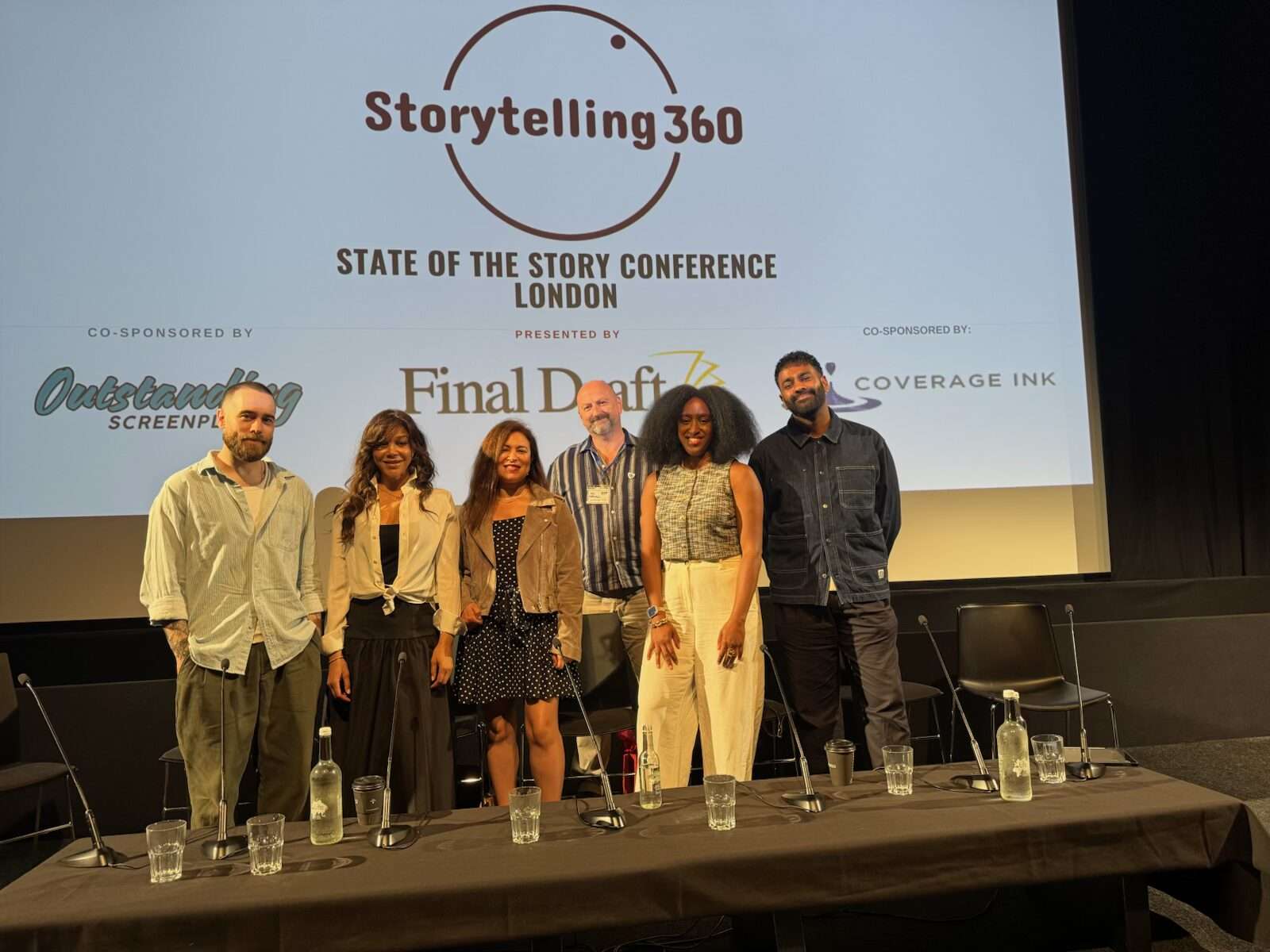
Neil Marshall, Joe Barton, Charmaine DeGraté, Monica Beletsky and Joy C. Mitchell on voice, notes and pitching
Storytelling360 | Panel
Five writers on how you find out what your own work sounds like, and what to do once somebody tells you.
Edited for length and clarity.
How did you get in?
Joy C. Mitchell: I got started by coming to something like this.
I moved to Berlin about twelve years ago and went to a Berlinale panel. A showrunner was up there who was running Deutschland 83 at the time, and I just stood up and asked a question. I said, hi, I’m Joy, I just moved here from LA — do you feel like there’s a place for drama writers here?
And she said, yeah. Come talk to me after.
I ended up getting staffed on the second season. That was my big break. From coming to a panel like this.
Monica Beletsky: I started in theatre through most of my twenties, then moved to LA and got a job as a writers’ assistant on Lost for the fourth season.
That was my grad school — keeping track of every storyline and character across that season. I didn’t get a job right afterwards. But working as an assistant genuinely prepared me for the room.
Charmaine DeGraté: I applied to the Austin Film Festival and that gave me my leg up. I did well there, and the script led to me applying to the television programmes, and I got into the Warner Brothers Writers Workshop.
I was maybe halfway through the programme when Jason Rothenberg, showrunner on The 100, started interviewing people and for some reason said: you’re the one.
I went back and finished the programme. But that was the genesis.
Joe Barton: I originally wanted to direct. I didn’t know how to do that, but I was slightly inspired because I watched Love Actually and read that Richard Curtis was a writer who’d just directed this film.
So I thought — if I start writing scripts, eventually someone will let me direct one. I was eighteen or nineteen.
I sat in my house and wrote spec scripts for about three or four years, sending them off to agents, and they all turned me down. Kept doing that for years. Eventually one took me on and sent me round town for general meetings, and I got a job writing an episode of a show called Beaver Falls for E4.
That was my first television gig, and I built up from there.
I still haven’t directed.
What should an emerging writer actually write?
Monica Beletsky: When you’re emerging, “what is my voice” is a very abstract idea.
So one exercise I do is take a genre. What would be my medical show? My legal show? My romance movie, my sci-fi?
Because if you look at Shonda Rhimes, or the people behind any of these, they put their stamp on a genre in a way nobody else would. It’s almost like a cover song. How would you cover this genre?
That’s how you figure out your own voice. Took me a long time to realise it.
Joy C. Mitchell: Piggybacking on that — if you look at your body of work, there’s usually a through line.
A producer once pointed out to me that all my specs, and most of the shows I write on, have some element of fish out of water. Because I’ve lived in four different countries now, so I’m always the fish out of water. And I find a way, across different genres, to tell that story through different characters.
So find your through line. Try it in horror, try it in comedy, try it as a romance, try it as a thriller. Find whatever’s central to the story you’re constantly trying to tell.
Charmaine DeGraté: I wrote a period piece from my college thesis, and everyone said: don’t write period pieces. Nobody will read it, it’ll never win festivals.
But I felt passionate about it. It was originally a novel that I turned into a screenplay. And for the first three years of my career, that’s what landed me key interviews.
So write in your voice, in the genre you’re passionate about. But I also see real value in spec episodes of other people’s shows — because embodying a showrunner’s voice is a skill set, and that’s the job for the first three or four or five years.
Can you see your own voice?
Charmaine DeGraté: This is where community comes in. Showing your work to other writers, other producers, helps crystallise what it actually is.
TMI, but — I was in a therapy session and my therapist asked me to bring in some original work. We were talking about something and my grandfather, who’d passed away, came up. And he said: obviously all of your writing, this is your core wound.
I said, what?
He said, hold on. For the past five years you’ve written about six scripts. In every single one, in the teaser, in the cold open, a paternal figure dies.
And he said, we have so much work to do if you don’t realise this. We’re going to be together for a long time.
But what it made me realise is that I was really interested in how human beings metabolise drama. And it took an outside eye to show me.
Neil Marshall: It’s a really interesting concept that you can’t hear your own voice. It’s like you can’t smell your own cologne.
It takes other people, other opinions, to read your stuff and say — I can see thematic links, I can see stylistic links, something that establishes your voice.
A lot of what I’ve written is genre. Lots of death and mayhem. But recently I tried something completely out of my comfort zone, adapting a true story. I was adapting somebody else’s script, and I gave it to my friend JD to read.
And she said: I could tell the bits that you wrote.
And I said, well, how does that work? I didn’t know I had a voice like that. That’s readable in that way.
That’s fascinating to me.
Process.
Joy C. Mitchell: I’m a method writer.
In grad school I wrote a tennis rom-com, so I took tennis lessons all year, because I wanted to understand how my characters felt. I’m writing a pilot right now set on a farm, so I’ve been spending time on a farm. I wrote a romantic drama set in a hotel, and I wrote it in hotel lobbies and hotel bars, just to be in the atmosphere.
I used to be a journalist, so I interview people, do practical research, and then go sit in that world. Then I crank out a vomit draft as fast as possible, polish it, send it to my agent or some friends, get notes, and the writing actually begins.
Monica Beletsky: My greatest challenge is getting off social media. Take the apps off your phone. I’ve logged out of Instagram on my computer and I don’t remember the password, and that’s the only way I get anything done.
Then — I came up through American rooms, so a lot of planning. Boards at home, cards, outlines. A lot changes in the actual script, but the infrastructure means I know where I’m going.
Writing a script is like quilting. You’re creating each block, but they’re all interconnected.
And I like to immerse myself in the genre. Watch what other people have done, and find what hasn’t been done that I’d like to do.
Exposition. How do you hide it?
Monica Beletsky: My trick is a total trick. Put it in an action sequence.
The action should reveal character, but it’s also a wonderful way of folding in exposition the audience needs, without their eyes glazing over.
Joy C. Mitchell: A few ways. One is directing on the page with the setting — if a character wakes up in their bedroom, sneak the exposition into what the audience is seeing.
Another is good banter. Two characters, quick and fun, and you learn everything you need early.
And because I’ve written romance and thrillers — exposition in sex scenes and fight scenes. You can tell an enormous amount about a character, or about a relationship, from the way someone fights or the way someone is in bed. Both let you get it out without telling the audience directly.
Monica Beletsky: One of the worst pieces of advice you can get is don’t direct on the page. If you’re writing, you have to be thinking about all the elements.
In that moment you are the director, you are the actors, you’re the editor, the costume designer, the composer. You’re everything.
The best writing has an eye on the final thing. Otherwise it’s just a novel.
Notes.
Neil Marshall: The cliché of the terrible exec note is very powerful. But a good note is a complete lifesaver.
We all know writers who reached a level of their career where they don’t take notes any more, and none of them are doing their best work. Because there’s nobody there to tell them not to do all of that. When you don’t get notes, that’s a dangerous place to be.
Execs are like anything else — you get good ones and bad ones. And when you’ve got a good collaborator who’s read your work and says okay, this is this, but what about this and that — it’s incredibly helpful.
The bad situation is when notes are given out of fear rather than creativity. You get channel notes that aren’t really about the story. They’re about the idea of who might be watching and what they might be thinking.
And the compliment sandwich — well, the sh*t sandwich. When you get it, you read the exec giving it and think, oh, they’re just trying to manage me. And then when you don’t get it, you think: I want my sandwich.
You can’t write in a bubble. Sooner or later you have to collaborate, and therefore you’re going to get notes. Like Thanos, notes are inevitable. And that’s a good thing.
But here’s the thing. Good notes are questions. Bad notes are suggestions.
Questions are great, because they want to inspire you to come up with answers, or to challenge them. When people start suggesting things to you, that’s when it gets your back up — especially if they’re really bad suggestions.
A good producer asks you questions and forces you to come up with ideas and put your voice into it.
Joy C. Mitchell: They’ve hired you to be a writer and to be creative. They hired you for your voice and your point of view.
So if you ask me a question and I can fix the problem through my lens, I’ll fix it. But if you give me a suggestion, then that’s you, and that’s not me. You’re not going to get the best work from a writer by saying: do this, write it this way.
Monica Beletsky: When you’re giving or getting feedback, keep it in the world of intent.
What goes off the rails with suggestions is — instead of “why is the character doing that, because I’m confused,” you get “what if the character did this and this.” That bumps you the wrong way, because it isn’t your intention for that character.
If everyone’s working on the same piece with the same intention, you can ask it that way. What are you trying to get across here? Intention is a good framework.
Charmaine DeGraté: I got a note once where I understood where he wanted to go. It was obviously a worst-case-scenario pitch, and I didn’t take it — but I understood the note behind the note. I knew what he was trying to get at.
A little charm goes a long way.
The writer–director relationship.
Neil Marshall: Speaking from my TV work — you park your ego at the door. It’s somebody else’s baby this time, and you’re there to service their story and respect their words.
I’ve done good and bad collaborations. On a bad one it’s you’ve got to do it this way. On a good one, like Game of Thrones, they invited us in — we want your opinions as directors, your ideas, and we’ll work the script around some of them.
The obvious example is my first Game of Thrones episode, the Battle of the Blackwater.
Those guys are brilliant writers, but they’re not military strategists. And I love military strategy. So I came in and rewrote the battle to make sense, because it didn’t make sense at all. It was literally forty thousand people standing next to a door.
I said, that doesn’t work. You need grappling hooks and ladders and siege engines.
And they added all of it into the script and structured it around that. Perfect example of the collaboration.
Monica Beletsky: We do something called a tone meeting, and it can be really difficult if the director doesn’t want to do one. You go through every scene and every page and download everything you know the scene needs — because you’d be surprised what you think is understood that isn’t.
Then you and the director go into rehearsal and shooting genuinely on the same page. In an ideal world you bring the best out of each other.
Charmaine DeGraté: I didn’t even know opting out of a tone meeting was an option. That’s insane.
Pitching.
Joy C. Mitchell: Pitching in America is more of a song and dance. You’re pitching yourself as much as the show and its tone. You perform, the way an actor would — memorise the pitch, or bullet points, and perform the story of your show theatrically.
In the UK it’s different. You write your pitch out and send it, and you might not meet whoever buys it until after they’ve bought your show.
Monica Beletsky: I’m not a natural pitcher. I’m not a natural public speaker. I’m like — can I just send the document?
But it’s one of those things you have to do. So I start with: is this a good idea? It sounds simple, but if you describe the idea, are people leaning in?
Then, why are you writing it. Who is this person, why do we care about them, what’s the core relationship we’re going to invest in, and where is this going.
I’m old school, I don’t do pitch decks. So it’s really about engaging them in a setup where they think, oh, I want to see that.
A lot of it is: can you make them feel something in the pitch? A popular pop song made you feel something. A popular comedy made you laugh. People have teared up in my pitches when it’s a drama. You want them walking away thinking — she made me feel that in the pitch, so she can make me feel it in the script.
Charmaine DeGraté: I sold a pitch, and later ran into the exec who bought it. She said, I loved your pitch so much.
And then she asked me a question that made me realise she did not remember one plot point.
I say that with love — she was completely genuine. But what it crystallised is that people won’t remember plot. They’re like audiences. Sure, they’ll remember a good twist. But they’ll remember how you made them feel.
I avoided pitching for the first four years of my career. It held me back. I’d do professional gymnastics to get out of it, because I had a debilitating fear of it.
What clicked was the personal story. The second you find the humanity in it and why you are the person telling it. I’d been rejecting the performative side — the jazz hands isn’t for me, I’m not in front of the camera, that’s not my journey.
But once I unearthed my emotional connection, that became my connection to whoever was on the receiving end. And then it stops being fight-or-flight and becomes a human conversation.
You will not die. You will leave that room. They are not going to kill you. And if they invited you in, they’re rooting for you.
And what cured you?
Baptism by fire. My first feature pitch. I was working with experienced, lovely producers and we’d rehearsed for three weeks, and they said: you are such a fun human being, but you are a robot when you pitch. It is terrible.
Which was helpful.
So I arrived hyper-prepared. I had the pitch on note cards and also on my iPad.
And they took both off me.
I thought: I’m going to die. I’m definitely going to die.
And I had to sit down and actually pitch. And it sounded like a human speaking, for the first time ever.
It worked because I’d rehearsed so much that I genuinely knew the story and knew why I was doing it. There was a forced trust, but the preparation was what allowed it. And it was a much more fun pitch than it would have been with all my tools.
Joy C. Mitchell: The best advice I’ve had for pitching is either pretend you’re telling the story at a campfire — you want people to lean in — or pretend you’re gossiping to your best friend.
Like if I saw Sinners and went back to my best friend and said, so I just saw this movie about vampires and there was this and this. You’re telling them enough that they want to go and watch it.
That’s pitching. You’re telling execs enough to make them lean in and want to know more, so they buy the show and pay you to know more.
Final advice.
Joy C. Mitchell: In 2026 — find a way to make your show or film in some format. Even if it isn’t a TV show or a movie yet. A short film, a short story, a podcast. Just find a way to put your story out there, because the industry is changing.
Fortune favours the brave. Don’t wait for Hollywood to find you or pick you. Pick yourself.
Monica Beletsky: Two things. Networking never worked for me — it’s not something I’m good at or ever found fruitful. So instead: make friends. The idea of making contacts doesn’t mean anything to me. Make friends, because those are the people creating great things themselves, who’ll give you feedback, who’ll inspire you, who you’ll come up with and collaborate with and who’ll be there while you persevere.
And the other thing: most emerging writers don’t rewrite as much as we do. I’ve worked for some of the best writers in the business, and only one of them is really a first-draft writer, which is questionable. We rewrite far more than you realise. I’ve been doing this seventeen years and I still have to change things constantly.
So ask yourself: could this scene happen? Yes. Does this scene need to happen? Often, no.
Make it so that every scene in your script has to happen, not just could. That will elevate your writing.
Charmaine DeGraté: Consume everything. Read scripts, read scripts, read scripts. We immerse ourselves in films and television, but as a writer, seeing it on the page is essential — understanding how it’s designed, how it’s structured.
And there’s a certain martyrdom going on right now. The sky is falling, there are no jobs, the market’s shrinking. Every generation has a version of this conversation.
We’re in a weird time, but we’ll find our footing. So keep your head down. Keep working. Keep writing. Don’t listen to all the chicken little.
Humans have been sharing stories for thousands of years. We’re designed to digest story, and that’s never going away. There will always be opportunity for stories, and always a yearning for them. All the talk about AI — it’ll get incorporated somehow. But what will never get replaced is humanity.
Joe Barton: Write the thing you feel passionately about rather than second-guessing the industry and writing a genre you think is more likely to sell. You’re much more likely to do your best work if you really connect to it.
And when people are starting out they often think their first script is the one they need to sell. I speak to people who say, I’ve written this script, I really want to sell it. And it probably isn’t going to. That’s not what your first couple of scripts are for.
What you’re doing when you’re starting out is developing your voice and developing yourself as a writer. The best thing that can come out of it is that you show it to people and they see something in you. Maybe it sells. But what you’re really selling is yourself.
And it was said in the last panel, but it’s worth repeating: don’t be a dick. Whether you’re a writer, producer, director, actor. Nobody wants to work with a dick. Life’s too short and the industry’s too hard.
As Bill and Ted say — be excellent to each other.
Good notes are questions. Bad notes are suggestions.
Neil Marshall speaking on stage at State of the Story, BFI Southbank, London
This conversation is drawn from Series That Travel, a panel discussion at Storytelling360’s State of the Story conference at BFI Southbank, London. Storytelling360 members can watch the full session on demand.